
Portland, Oregon • Independent total loss appraisals
Portland total loss appraisal.
Get your LEVERAGE back.
Totaled in a collision, stolen or recovered? Have Ken check the insurance offer against your vehicle and the market evidence.
Ken Nix works for vehicle owners, not insurance companies. Get an Oregon-focused appraisal backed by vehicle research, local market evidence and experience.

Your appraiser
Who is Ken Nix?
I've been appraising vehicles since 1989, including vehicles at the dealerships where I worked. Before becoming an independent auto appraiser, I spent approximately 18 years in automotive dealerships, including appraising vehicles. I have now worked as an Oregon-certified independent appraiser for more than 16 years. That experience matters when the question is what a real vehicle is worth.
My computer experience goes back to being a COBOL programmer in the 1980s. As an early adopter of AI, I use tools I have developed to support vehicle research, while personally checking the evidence behind each appraisal.
Today, my focus is helping consumers with total loss claims. From daily drivers and diesel trucks to exotics, classics and camper conversions, I look beyond the model name and the computer-generated number.
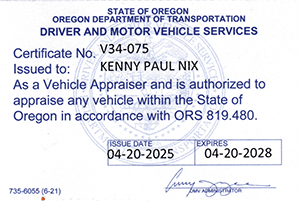
Oregon state-issued vehicle appraiser certificate #V34-075. You can view my certificate here and learn more about my experience below.
Read Ken's full bio →Find your next step
The right route depends on
whose insurer is paying.
Pick your situation. No account, claim number, or contact details needed.
Your policy is the starting point
Check the evidence. Then check your appraisal clause.
Ask for the complete valuation report and your policy's appraisal wording. If documented corrections do not resolve the value dispute, an appraisal process may be available. Coverage and fault are separate questions from vehicle value. Our appraisal-clause representation is for claims under your own policy. You need collision coverage for a collision loss, or comprehensive coverage for a covered theft or other comprehensive loss, plus an applicable appraisal provision. Being hit by another driver does not prevent you from using your own applicable coverage.
Save the offer and every page of the valuation.
Use the checklist below to organize your evidence.
Request corrections, then have us assess whether appraisal is the right route.
Why consider using your own coverage?
Your policy may give you a defined appraisal process for a disagreement over value. That can provide a more direct route than continuing a back-and-forth with another driver's insurer. LEVERAGE handles accepted appraisal-clause assignments as your appointed appraiser.
Confirm coverage, the deductible and any appraisal or umpire costs first. This route does not automatically mean a higher payment. If another driver is responsible, ask your insurer how deductible recovery will be handled.
Receive the undisputed payment. Keep pursuing the rest.
With your own insurer, you may be able to receive the amount of the offer that is not in dispute while continuing to challenge the vehicle’s value, including through your policy’s appraisal clause.
Oregon’s total-loss notice requires that payment when you agree to complete the necessary ownership-transfer documents and allow the insurer to take possession. This requirement does not apply if you keep the damaged vehicle. Receiving the undisputed amount does not itself settle the remaining value dispute. Review any release separately.
Oregon requires reimbursement when these conditions are met.
If your policy includes an appraisal provision and the final appraised value is greater than your insurer’s last offer, Oregon’s notice says your insurer must reimburse your reasonable appraisal costs. Keep the final appraisal, the last offer and your invoice. Ask the adjuster for reimbursement in writing.
Oregon Vehicle Total Loss Notice: payment and appraisal rights ↗
A third-party claim
You can dispute the offer. Your options are different.
You cannot invoke the other driver's appraisal clause. LEVERAGE can provide an independent appraisal report for a third-party claim, but we do not provide one-on-one support, negotiation or claim handling for third-party claims. Request the full valuation and document specific errors.
If the claim is going nowhere and you have applicable collision coverage, ask your own insurer whether you can pursue the loss under your policy. Confirm the deductible and the appraisal provision before deciding. Do not assume the other driver's insurer must accept an independent appraisal.
Let's identify the route
Look at who sent the offer and which policy is involved.
If the claim is under your collision or comprehensive coverage, it is a claim with your insurer. If you are asking another driver's liability insurer to pay, it is a third-party claim. The same insurance brand can appear on both sides, so check the policy and claim details.
Send the valuation and explain what happened. We will help identify the appropriate appraisal service. If the vehicle was stolen or recovered, include that detail in your request.
Oregon DFR: your insurer, third-party claims and appraisal options ↗
Before accepting the offer
Check the car they valued.
Is it actually your car?
CCC ONE, Mitchell and other valuation reports contain details worth checking. Use this list beside your report. Checkmarks are only a reading aid and do not submit information.
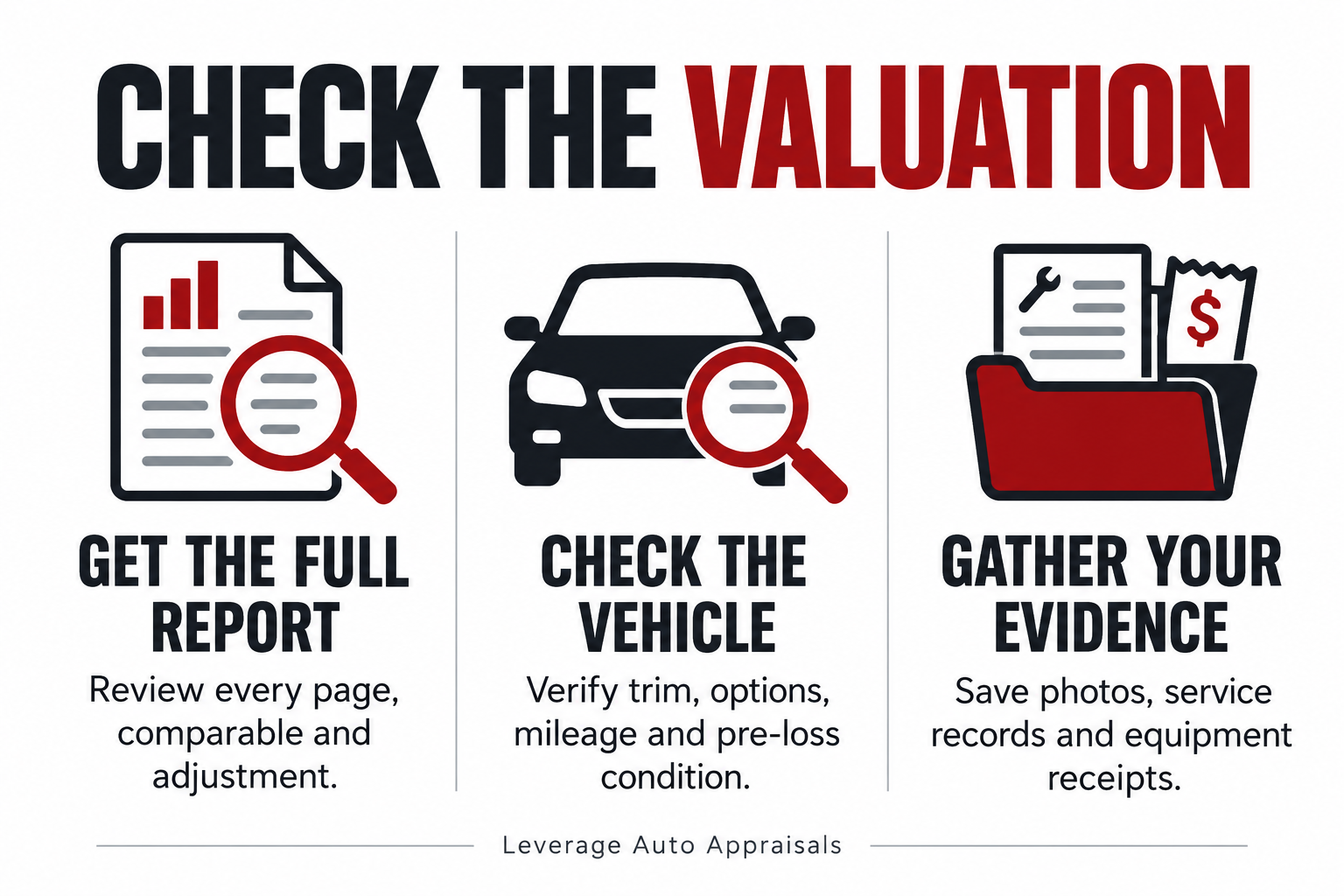
CCC ONE and other valuation reports
Three red flags that deserve a closer look.
These are examples of review priorities, not findings about your report. A flag tells us what to investigate; the complete calculation and supporting evidence determine whether an adjustment is justified.
Uniform condition deductions
If both comparable vehicles receive an identical condition deduction, ask what supports it. Is it a standard adjustment to a common condition baseline, or is it based on evidence about those particular vehicles?
Review any positive condition adjustment to your vehicle too. Identical deductions alone do not establish an error. An unexplained deduction that materially reduces the result needs professional attention.
Extreme mileage discrepancy
A wrong odometer entry or a comparable with very different mileage can distort the comparison. Check the loss-date mileage against records, then examine the amount and direction of each mileage adjustment.
Ask how the mileage difference was accounted for and whether closer-mileage vehicles were available. A large gap needs a supported adjustment, not an assumption.
Comparable outside the local market
A comparable sourced more than 500 miles away raises questions about local availability and market differences. Ask why it was selected and whether closer matches were considered.
Distance is not an automatic disqualification, especially for rare vehicles. The appraiser should explain why that market is relevant to your Portland vehicle.
Need a professional review?
LEVERAGE Auto Appraisals specializes in representing consumers in total loss appraisal-clause disputes. A computer-generated red flag review cannot replace a full market appraisal or professional analysis.
Request a FREE Red Flag Review ↗Beware of storage fees
“We'll bill the insurance company”
does not mean you are protected.
“We’ll never charge you. We’ll only charge the insurance company.” Do not mistake that promise for protection. The shop may send its bill to the insurer, but that does not mean the insurer has agreed to cover every additional storage day. The insurer may seek to deduct disputed storage charges from your claim payment, or you may be left responsible for uncovered charges. Either way, it can mean less money in your pocket.
The offer can start the clock.
Oregon DFR says insurers usually pay storage through the day they make an offer. You may be responsible after that. Treat a total-loss offer and any storage cutoff notice as something to address immediately, even if you dispute the value.
A request to move it matters.
If the insurer asks to move the vehicle to reduce storage costs and you refuse, additional charges may fall to you. Get the proposed destination, pickup arrangement and payment cutoff in writing.
The bill adds up fast.
Ken has encountered shops charging as much as $250 per day. At that rate, 10 days is $2,500; 30 days is $7,500. These are examples, not a standard Portland rate. Ask your shop for its actual daily charges.
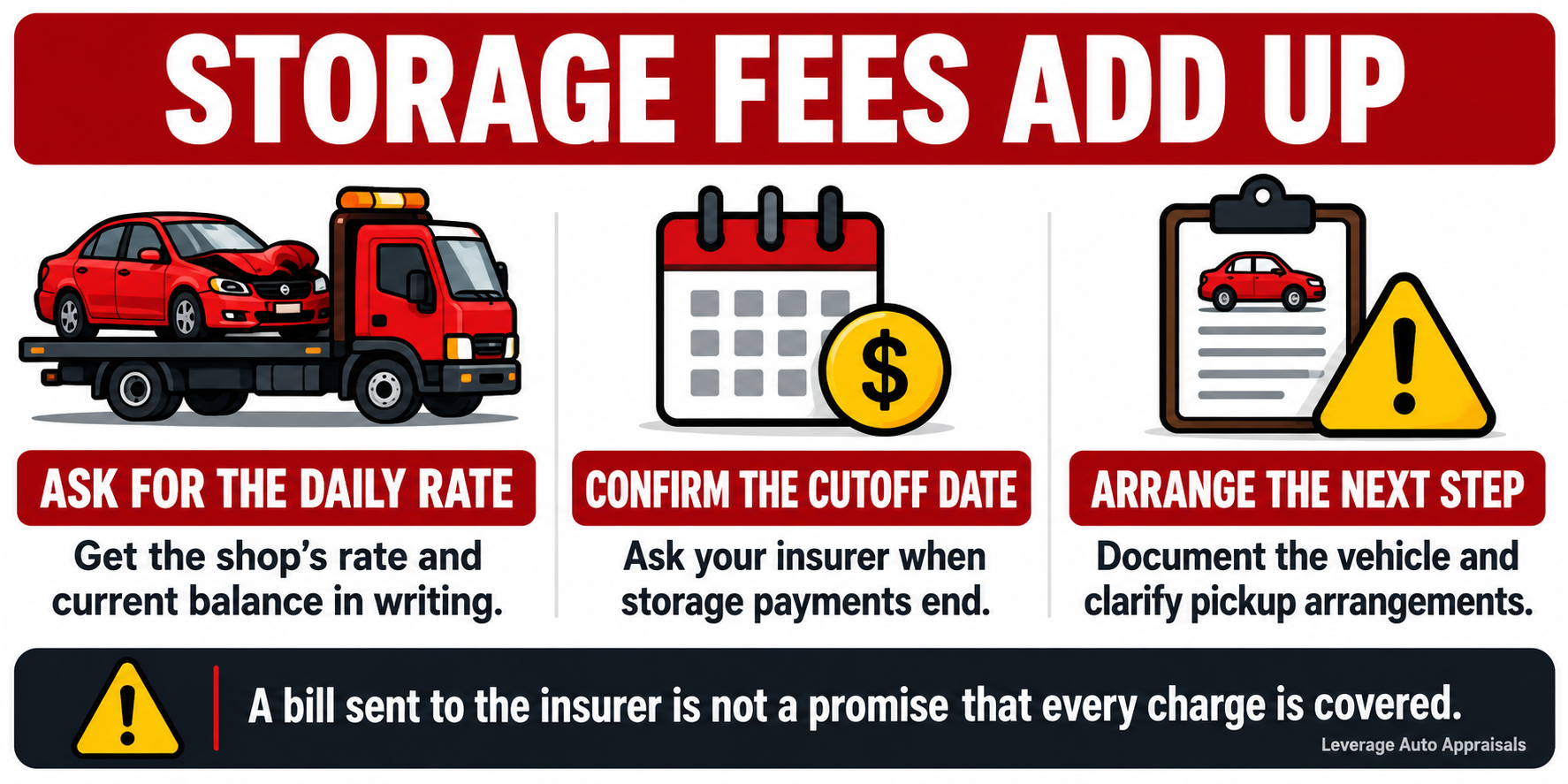
The shop’s billing promise is not the insurer’s agreement to pay.
Ken regularly sees storage charges become a problem during total loss disputes. Do not let daily charges keep running while you argue over the vehicle’s value. Ask the insurer to confirm the last covered storage day and arrange the next step promptly.
Ask these questions today.
- To the shop: What is the daily rate, current balance and written storage agreement? If the insurer refuses any charges, who is responsible?
- To the adjuster: What exact date does storage payment end? Has every charge been authorized? What is needed to release and move the vehicle?
- Before the move: Preserve photos, records and needed inspection access. Clarify whether you are authorizing transport, transferring ownership or signing a settlement release.
- For the rental: Confirm the last covered day, rate and any extension in writing. Returning the rental and disputing the valuation are separate decisions.
Do not rely on “don't worry.” Get the actual payment agreement. If storage is deducted from a proposed payment, request an itemized explanation and the policy or legal basis. Do not assume a proposed deduction is automatically valid. Ask how much you will actually receive after every proposed deduction.
Oregon DFR: storage fees and rental coverage after a total loss ↗
A costly lesson from Ken's experience
A G-Wagon, a year-long dispute and six-figure expenses.
Ken recalls a client whose Mercedes-Benz G-Wagon had been sitting at a body shop for more than a year while the value was disputed. The client was also renting another G-Wagon, and the insurer had not paid the vehicle settlement.
According to Ken, the claimed charges had grown to more than $90,000 in storage and more than $160,000 in rental fees. He reports working with the insurer to reduce both amounts by nearly 40%.
This was an unusually large case. The same problem can happen with a much smaller claim: daily expenses keep growing while everyone argues about the vehicle's value.
An anonymized account provided by Ken Nix. Figures are approximate and describe charges claimed, not a statement that the client ultimately paid those full amounts.
You may not have to wait for every dollar
Ask about the undisputed payment.
Oregon's required total-loss notice explains that, when the necessary ownership-transfer documents are agreed to and the insurer can take possession, the insurer must pay the amount not in dispute. The notice excludes this requirement when you keep the damaged vehicle.
Receiving the undisputed amount does not itself settle the value dispute. You can continue seeking additional payment. Check the paperwork carefully and distinguish a vehicle transfer from a release of your remaining claim.
Protect the money already on the table while you challenge the rest.
Read Oregon's total-loss notice ↗Portland theft-related insurance claims
They stole your vehicle.
Don't lose its value in the paperwork.
Your truck's equipment, your car's condition and the work you put into it did not disappear from its pre-theft value just because the vehicle disappeared. Those details need evidence.
Still missing?
Keep the police report number, both sets of keys if available, purchase records, service history and photographs from before the theft. Ask the insurer what documents and timing its theft investigation requires.
A missing car is not a reason to guess at the trim, options or condition. Your records can help reconstruct what you owned.
Recovered with damage?
Photograph the exterior, interior, odometer, missing equipment and visible damage before cleanup or repairs, when access is safe and permitted. Save tow, recovery and inspection records.
Do not handle unfamiliar substances or sharp objects. Ask the insurer about a qualified inspection when contamination, mechanical damage or safety concerns are suspected.
Declared a total loss?
Review the value immediately before the theft or covered loss. Separate theft-related damage from any claim that the vehicle was already in poor condition.
Bring us the complete valuation, not just the final number. We can examine the equipment, comparables and adjustments that produced the offer.
Community help locating a stolen vehicle
Facebook communities such as PDX Stolen Cars and PNW Stolen Cars can help share a stolen-vehicle post and gather possible sightings. Follow each group’s posting rules and provide clear vehicle photos and the police report number where appropriate.
- PDX Stolen Cars on Facebook ↗
- Additional stolen-vehicle recovery community ↗
- Additional regional recovery group ↗
These are independent community resources. Report theft and possible sightings to police. Do not confront anyone or try to recover the vehicle yourself.
Report suspected theft to the law-enforcement agency responsible for the location. The following Portland resources apply to incidents in Portland: Portland towing and vehicle-location information ↗ · Portland Police reporting guidance ↗
Portland, Oregon
Your search should follow the vehicle market.
Not stop at a city-limit sign.
Portland spans a broad metro market, with neighborhood travel patterns and cross-river shopping that can lead owners well beyond the city boundary.
Nearby communities are research starting points, not automatic proof of value.
A research starting point
Portland · Your starting location
Regional connections, not a map, required radius or live inventory feed.
Build a defensible comparison set
- Start near where the vehicle was normally kept. Match configuration, equipment and condition.
- Expand for a reason. Record why a rare trim or limited inventory required a wider search. Ask why the insurer expanded its search, too.
- Keep the evidence. Save listing dates, VINs, seller locations, prices, mileage and relevant differences.
- Explain the differences. A lower price, different drivetrain or prior damage needs examination. A higher price is not automatically better evidence.
What to check in this comparison set
An Oregon listing and a Washington listing may need different treatment of taxes and fees. Keep those amounts separate from the vehicle price.
Do not add a local premium just because a vehicle is in Portland. Actual comparable evidence must support the value argument. This page does not measure current inventory or claim a regional price advantage.
Your insurance company is not your appraiser
Who made the offer?
Whether the report came through one of these companies or another carrier, we start with your vehicle and the evidence. Include the insurer's name and whether it is your policy in your free review request.
Insurer names describe claim situations. LEVERAGE is independent and is not affiliated with these insurers. The underwriting company and your policy wording determine the applicable process.
Start with a FREE Red Flag Review
Before you accept the offer,
find out what deserves a closer look.
Send every page of your insurer’s valuation to LEVERAGE. Request a free Red Flag Review to identify details that may need further investigation, including mileage adjustments, condition deductions and comparable vehicles.
Example from a Red Flag Review
Mileage analysis: does the calculation make sense?
This recreated excerpt uses selected figures from a review. Client and vehicle identifiers, claim details, dates and dealer information are omitted.
| Example | Mileage gap | Mileage deduction | Effective rate |
|---|---|---|---|
| Comparable A | 21,240 miles | $1,935 | About 9.1¢ per mile |
| Comparable B | 47,605 miles | $3,514 | About 7.4¢ per mile |
The effective rate is the mileage adjustment divided by the mileage gap. Ask how the provider calculated each adjustment and whether the method reasonably accounts for the vehicles’ differences.
Too large a deduction or too small an addition can lower an adjusted comparable’s value. In the example above, however, a smaller deduction would raise that comparable’s adjusted value. Mileage effects can also be nonlinear. A rate difference alone does not prove an error or manipulation.
A red flag is a question to investigate. We review the complete calculation and underlying evidence before reaching an appraisal conclusion.
Need a professional review?
The initial Red Flag Review is free. A computer-generated review cannot replace a full market appraisal or professional analysis. If you need a formal appraisal, request a free estimate for your vehicle and assignment. We explain the scope and flat fee before you decide.
Look beyond the advertisement
“Front-line ready” is a claim.
We look for the evidence.
A comparable in a CCC ONE or Mitchell report, or in an opposing appraiser’s report, deserves the same scrutiny as your vehicle. A polished advertisement does not establish its current mileage, condition or history. Ken examines the details that can make an apparently similar vehicle a poor comparison.
Is the listing still accurate?
How old are the photos? Is the vehicle still for sale? Has it been used as a demonstrator or driven by the dealer since the mileage was advertised? We look for changes in price, mileage and time on the market, then seek current information where needed.
Does the condition match?
Dents, door dings, damaged trim, worn interiors and incomplete reconditioning can matter. Photos may reveal issues, while odors, mechanical concerns or damage outside the camera’s view may require further documentation or inspection.
Calling a vehicle “excellent” does not resolve those questions.
What does the history show?
Prior damage, title branding, Canadian import history and possible salt exposure are reasons to investigate further. We consider the available records and supporting evidence instead of assuming an origin or an apparently clean history report proves the vehicle’s condition.
A Canadian origin alone does not make a vehicle a bad comparable. Any adjustment needs evidence.
Technology helps us find questions. Ken checks the answers.
“I was a COBOL programmer in the 1980s, and I’ve been appraising vehicles since 1989. I’ve developed specialized software and AI-assisted tools to help research value and examine the vehicles used in competing appraisals. But I know how easily AI can be wrong, misled or biased. I review the evidence and make the final appraisal judgment myself.”
Ken Nix, LEVERAGE Auto Appraisals
AI-generated findings are research leads. We check them against source records and vehicle evidence before relying on them in an appraisal.
Better documentation starts with your vehicle
Your phone. Your vehicle.
A better documented inspection.
InspectIRL is proprietary vehicle-inspection software from LEVERAGE. When it suits the assignment, we can help you document your own vehicle with guided photos and inspection information, including date, time and location records.
This gives Ken more evidence to assess the vehicle’s condition and support the appraisal. It can also help identify areas needing closer attention before the report is completed.
Ask about InspectIRL when you request your free estimate. We first determine whether a guided owner inspection is appropriate for your case. Some concerns still require a physical inspection or a qualified specialist.
Get my free appraisal estimate ↗
InspectIRL
Call 503.420.3001 for a free estimate
Show what a valuation report may miss.
Document equipment, interior condition, visible damage, VIN and mileage with guidance tailored to the assignment.
Why choose LEVERAGE?
You should not have to become an appraiser to challenge an offer.
Ken researches the vehicle, checks the valuation and puts a supported opinion behind the dispute. For accepted appraisal-clause assignments, that includes working with the opposing appraiser through the policy process.
We work for consumers. We do not work for insurance companies.
- Send the full valuation report and vehicle details.
- We review the situation and explain the scope and flat fee.
- If you hire us, we build and defend the appraisal for the agreed assignment.
Watch: Why choose LEVERAGE Auto Appraisals.
Practical help around Portland
The right resource for the right question.
A repair shop assesses damage. An appraiser assesses value. An agency explains insurance products. A lawyer advises on legal issues.
All resources
Mackin's Auto Body Hollywood
3737 NE Broadway St, Portland, OR 97232
Ask about written estimates, storage rates and inspection access before authorizing work.
Visit official websiteMackin's Auto Body North Portland
8026 N Denver Ave, Portland, OR 97217
Ask about written estimates, storage rates and inspection access before authorizing work.
Visit official websiteShow 5 more resources
Mariko Locke, State Farm
5048A SE Hawthorne Blvd, Portland, OR 97215
Ask about coverage terms and exclusions. A new policy does not change a loss that has already occurred.
Visit official websiteGilda Arzola, State Farm
4000 SE 82nd Avenue Suite 1400, Portland, OR 97266
Ask about coverage terms and exclusions. A new policy does not change a loss that has already occurred.
Visit official websiteOregon State Bar Lawyer Referral Service
Statewide legal-help resource
Search for legal help by location and issue. Ask whether a lawyer handles an injury claim, coverage dispute or property-damage-only matter.
Visit official websiteOregon Division of Financial Regulation
Statewide insurance consumer resource
Read official total loss guidance and find help with insurance questions.
Visit official websiteOregon DMV
Statewide vehicle-title resource
Check totaled-vehicle, salvage-title and title-brand requirements before retaining or selling the vehicle.
Visit official websiteBody shops
Mackin's Auto Body Hollywood
3737 NE Broadway St, Portland, OR 97232
Ask about written estimates, storage rates and inspection access before authorizing work.
Visit official websiteMackin's Auto Body North Portland
8026 N Denver Ave, Portland, OR 97217
Ask about written estimates, storage rates and inspection access before authorizing work.
Visit official websiteInsurance agencies
Mariko Locke, State Farm
5048A SE Hawthorne Blvd, Portland, OR 97215
Ask about coverage terms and exclusions. A new policy does not change a loss that has already occurred.
Visit official websiteGilda Arzola, State Farm
4000 SE 82nd Avenue Suite 1400, Portland, OR 97266
Ask about coverage terms and exclusions. A new policy does not change a loss that has already occurred.
Visit official websiteAttorneys
Oregon State Bar Lawyer Referral Service
Statewide legal-help resource
Search for legal help by location and issue. Ask whether a lawyer handles an injury claim, coverage dispute or property-damage-only matter.
Visit official websitePublic resources
Oregon Division of Financial Regulation
Statewide insurance consumer resource
Read official total loss guidance and find help with insurance questions.
Visit official websiteOregon DMV
Statewide vehicle-title resource
Check totaled-vehicle, salvage-title and title-brand requirements before retaining or selling the vehicle.
Visit official websiteInformation only, not referrals. These selected listings are provided for convenience. Inclusion is not a recommendation, endorsement, partnership or guarantee of professional standing, quality, availability or results. Confirm current contact information, licensing, services and fees directly. Choose the provider appropriate to your situation. A listing does not create an attorney-client or other professional relationship with LEVERAGE.
Before you hire an appraiser
Ask who is valuing your vehicle.
And who they work for.
A professional title or a refund promise is not a substitute for documented valuation experience. Here are the questions Ken would ask.
Can I verify your state-issued vehicle appraiser credential?
Ask for the issuing state, certificate number, expiration date and a way to verify it. Ken holds Oregon Department of Transportation DMV vehicle appraiser certificate V34-075. A private training certificate is not the same as an Oregon state-issued vehicle appraiser certificate. If someone relies on an out-of-state credential, ask them to document their authority to perform your Oregon assignment.
Is your experience in vehicle value, or repair estimating?
Ask when the appraiser began determining vehicle market values and what that work involved. Repair estimating, service writing and claim adjusting are different kinds of experience. Ken has appraised vehicles since 1989, including approximately 18 years in automotive dealerships before more than 16 years as an Oregon-certified independent appraiser.
LEVERAGE follows the Uniform Standards of Professional Appraisal Practice (USPAP) in its appraisal work. Ask any appraiser about their research, documentation, independence and the standards used for your assignment.
Do you work for consumers or insurance companies?
Ken works only for consumers and never accepts appraisal assignments for insurance companies. Ask other appraisers who hires and pays them, whether they accept insurer assignments, and how they address conflicts of interest. Repeat business should never determine a vehicle’s supported value.
Where do you actually work?
LEVERAGE is an Oregon LLC with its main office in Portland, serving consumers throughout Oregon. Ask whether a listed address is a staffed office, an appointment location or a mailing address. Verify the business registration and ask where the appraiser handling your assignment actually works.
Does a minimum-increase guarantee define your stopping point?
Read the terms of any guarantee. Ask what happens if the evidence supports more than the advertised minimum and who decides when to agree on value. A $1,000 increase is not the goal simply because it meets a guarantee. Ken’s goal is a defensible vehicle value supported by the evidence, not the quickest agreement.
Read detailed reviews and case studies. Ask whether claimed results are individual examples, averages, or guaranteed outcomes. An example settlement does not promise the same result for your vehicle.
What is the full fee, and how does reimbursement work?
LEVERAGE uses an agreed flat fee disclosed before you hire us. Ask for the complete scope, any potential umpire costs and the documents needed for reimbursement.
For a claim under your own policy’s appraisal provision, Oregon requires reimbursement of reasonable appraisal costs when the final appraised value exceeds your insurer’s last offer. There is no $1,000 minimum increase in that rule. It concerns the final appraised value, not merely an appraiser’s initial demand, and covers reasonable appraisal costs. Keep the last offer, final determination and invoice. LEVERAGE helps you identify the documentation to request reimbursement.
From vehicle owners
Real claims. Real people.
Read what working with Ken is like.
Over 200 Oregon five-star reviews. Read what vehicle owners say about working with LEVERAGE.


Keep the information on your side
Useful guides. Real claim experience.
Take a closer look at valuation issues and the steps available to vehicle owners.
How to Read an Appraisal Report and Spot Valuation Errors
Learn what to check in a valuation report, from the vehicle description to the evidence behind the adjustments.
Read moreMileage Adjustment Valuation: How It Impacts Your Total-Loss
See why mileage adjustments deserve a closer look when comparing the insurer’s vehicles with your own.
Read moreTotal Loss Settlement Negotiation: A Complete Guide
Understand the steps in a total loss value dispute and how to prepare a clear, documented response.
Read morePortland total loss questions
Get clear on your next move.
Is my appraisal produced by AI?
No. Ken uses specialized software and AI-assisted research to help investigate vehicle value and comparables. He checks the underlying evidence and makes the final appraisal judgment. An automated result is not treated as a verified fact.
Can I document my vehicle myself with InspectIRL?
For suitable assignments, yes. LEVERAGE’s proprietary InspectIRL software helps owners provide guided inspection photos and supporting records. Ask about InspectIRL when you request your free estimate so we can determine whether it fits the assignment. It does not replace every type of physical or specialist inspection.
Can you help if my car was stolen rather than crashed?
Yes. A theft-related total loss still requires a supported vehicle valuation. Send the full report, the theft or recovery information and any pre-loss photographs or records. We first confirm whether the issue is vehicle value, coverage or repair scope.
What if the vehicle is recovered after the insurer pays?
Notify the insurer and police promptly. Ownership, recovery and settlement arrangements matter. Do not assume the vehicle is yours to keep or sell. Ask for written instructions before moving forward.
Can I use the appraisal clause against another driver’s insurer?
No. You cannot invoke the other driver’s appraisal clause. We can provide an independent appraisal report for a third-party claim, but do not provide one-on-one support, negotiation or claim handling for it. Our appraisal-clause representation requires a claim under your own applicable collision or comprehensive coverage and an appraisal provision.
Will Oregon reimburse my appraisal fee?
Oregon’s total-loss notice says that, for a claim with your own insurer under an appraisal provision, reasonable appraisal costs must be reimbursed if the final appraised value exceeds the insurer’s last offer. We can review the assignment before you commit.
Can I keep my totaled vehicle?
Keeping it generally means a salvage-value deduction. Before deciding, check title requirements, repair and inspection needs, insurance availability and your lender’s requirements. Ask for a written owner-retained settlement breakdown.
How much does LEVERAGE charge?
Start with a FREE Red Flag Review. Appraisals start as low as $399. Request a free estimate for your vehicle and assignment; we explain the fee and scope before you hire us.
What should I send for the free review?
Send every page of the insurer’s valuation, the offer, year, make, model, mileage and the main reason you disagree. For theft, include available pre-theft photos, equipment records and recovery documentation. Use the full claim-review form so the details stay together.
Oregon DFR total-loss notice ↗ · Oregon total loss guidance ↗
Portland, Oregon total loss appraisal
Before you accept the number,
let's look at the evidence.
Send us the report. Tell us about your vehicle. We will help you understand whether a LEVERAGE appraisal is the right next step.
Request my FREE Red Flag ReviewVehicle-value services and general claim information. Coverage and legal disputes may require separate advice.

