
LEVERAGE · Oregon consumer guides
The report behind the offer
deserves a closer look.
“I Don’t Just Read Their Reports. I Dismantle Them.”
— Ken Nix
CCC, Mitchell or another valuation: learn where to check vehicle details, comparable listings and adjustments before deciding whether the number is supported.
200-plus five-star reviews · We work for you, not the insurance companies.
Which valuation report did you receive?
Choose the name on your report. The provider’s name alone does not establish whether the offer is fair. The inputs, comparison vehicles and supported adjustments matter.
CCC
If the report identifies CCC, start with the loss-vehicle description and equipment, then follow the comparable vehicles and adjustments to the final value. Section names and report formats can vary.
- Match trim, packages, engine and drivetrain to records for your vehicle.
- Separate adjustments to comparable vehicles from deductions applied to your vehicle.
- Check the description and evidence behind condition ratings.
- Ask for the report’s explanation of any normalization or other adjustment you cannot reproduce.
Mitchell
If the report identifies Mitchell or WorkCenter Total Loss, check how the vehicle was configured and how the valuation and adjustment sections connect. Mitchell documentation describes condition, prior damage, aftermarket and refurbishment inputs.
- Check condition categories against dated photographs and records.
- Identify whether an adjustment is manual, percentage-based or derived by the system.
- If a projected sold or similar adjustment appears, ask what supports it in this report.
- Confirm mileage, options and the comparable-vehicle details before comparing the final amounts.
Audatex / other
For Audatex, another platform or a custom appraiser report, begin with the same audit trail: vehicle identification, market evidence, adjustments and conclusion.
- Find the report provider and preparation date.
- Request missing comparable listings and the explanation of each adjustment.
- Check whether the report uses asking prices, sold prices or another stated basis.
- Ask the author to explain any step between the source evidence and the final value.
Not sure
Look at the first page, footer and report title. A repair estimate is not the same as the market valuation. Ask the adjuster for the complete report used to establish your vehicle’s pre-loss value.
You do not have to identify the software before contacting us. Send all pages through the free review form.
Six places to look more closely.
1. The wrong version of your vehicle.
Engine, drivetrain, trim, cab, bed length, seating, battery configuration and factory options can change the comparison. Match the report to build information, photographs and equipment documentation.
2. Mileage adjustments that need explanation.
Check the direction and size of each adjustment, whose mileage is being adjusted and whether the calculation is consistent with the report’s method. Different vehicles need not share a single cents-per-mile rate. Ask what supports the rate rather than substituting an arbitrary rate that produces a preferred number.
3. A comparable that is not truly comparable.
A familiar model name can conceal a different drivetrain, trim, title history or condition. Check seller records and available history. Imported vehicles, previous damage or reconditioning gaps deserve investigation; the listing alone may not resolve those questions.
4. Stale listings or unverified condition.
Save the listing date and ask whether mileage, availability and condition have changed. Dealer use, lot wear or fresh damage may not appear in older advertising. Confirm facts before treating any of these as a valuation defect.
5. Deductions without a clear basis.
Find the photographs, notes or repair information supporting a condition or prior-damage adjustment. Check whether the same concern appears in more than one deduction. Ask how its effect on market value was determined.
6. Missing equipment or unsupported credits.
Document options, modifications, recent major work and relevant accessories. An invoice does not automatically add its full cost to market value. The issue is whether the item was accounted for and how the evidence supports its contribution.
See why the calculation deserves a closer look.
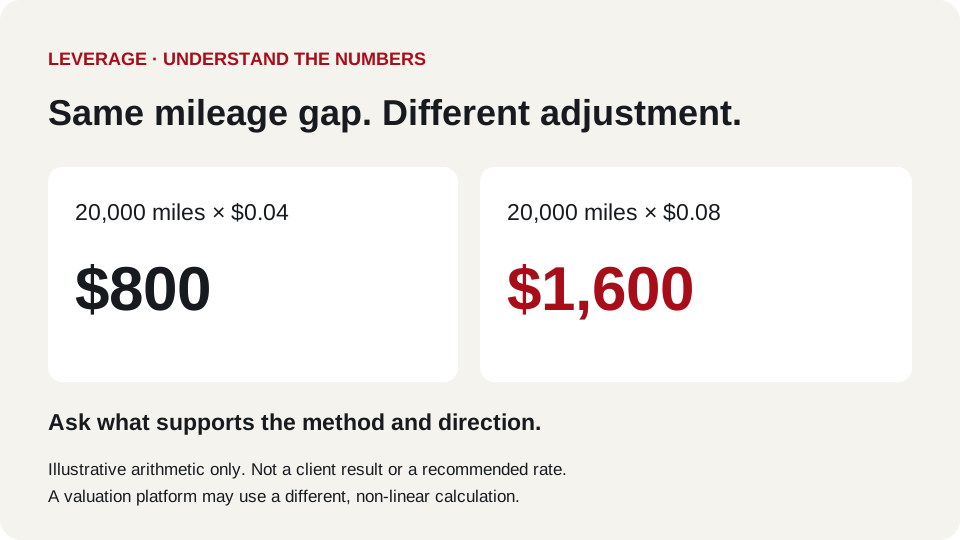
A useful Red Flag Review explains the inputs and evidence. A different number alone does not establish manipulation or intentional misconduct.
Turn a concern into a reviewable question.
For each issue, record the page number, the entry you question, the evidence you have and the explanation or correction you are requesting. Keep an unedited copy of every report version.
- Every page of the valuation report, including comparable vehicles and adjustments.
- The written offer and settlement breakdown, plus the date of each revision.
- Vehicle year, make, model, trim, drivetrain and mileage at the loss.
- Pre-loss photographs, equipment records and relevant maintenance or upgrade receipts.
- Your policy’s appraisal provision, if the claim is through your own insurer.
Ken uses purpose-built research tools and AI to assist analysis, with human review of the appraisal. His computer experience goes back to being a COBOL programmer in the 1980s. Tools can make mistakes; source evidence and professional judgment remain essential.
Can I provide my own inspection photos?
Ask whether LEVERAGE’s proprietary InspectIRL guided inspection software fits your assignment. We provide direction when it is appropriate. It is part of the LEVERAGE workflow and does not replace every specialist inspection.
A report can look precise and still describe the wrong car.
Start with the identity of the vehicle. A truck’s cab, bed, engine, axle configuration and trim can matter more than a familiar badge. With an EV, check battery and drivetrain configuration. With a conversion van, separate the base vehicle from the documented conversion. A report is only useful if the inputs represent what you owned.
Then check each comparable as a real vehicle. Ask the seller whether it was retail-ready, available on the relevant date and still at the advertised mileage. A vehicle that has sat for months may have been used, damaged or repriced. A Canadian origin or salt-state history calls for investigation; it is not proof of a branded title or rust. Save what you can establish, not what you suspect.
A uniform adjustment appears on every comparable. Is that automatically wrong?
No. It is a reason to ask what the adjustment does, whether it overlaps another deduction, and what supports the amount. Request the method and the factual basis. Consistency alone does not establish fairness; a repeated number alone does not establish fraud.
Can I multiply the mileage difference by my own rate?
That can illustrate a question, but it does not establish the correct adjustment. Vehicle age, model, mileage range and the provider’s method may affect the calculation. Identify the direction first: is the comparable being adjusted to your vehicle, or is the report changing your vehicle’s value?
Can photographs prove a condition error?
Dated, clear pre-loss photos can be strong evidence. Collision photos document the loss damage but may not establish how a panel looked before impact. Match each photo to the disputed category and distinguish pre-existing damage from damage caused by the insured event.
Wording you can adapt
On page __, the report applies __ to comparable __. Please explain the purpose, direction and calculation of that adjustment, the supporting market evidence, and whether the same difference is accounted for elsewhere. My supporting records are attached.
Three Oregon protections worth understanding.
The report behind the offer
ORS 742.554 requires the valuation or appraisal reports relied on for the total-loss cash offer, along with the required notice. Ask for every page and each revision. This applies to an insured or a third-party vehicle owner; receiving a report does not create a right to invoke someone else’s policy.
The amount that is not in dispute
Under ORS 742.558, payment of the undisputed vehicle value requires agreement to execute ownership-transfer documents and authorization for an insurer-paid move to a disclosed location. The vehicle must remain available there for inspection and evaluation for at least 14 calendar days. After that period it may be sold for salvage. Acceptance of that statutory payment alone does not waive the additional value claim. Read any separate release before signing; arrange inspection promptly.
Reasonable appraisal-cost reimbursement
ORS 742.466 requires reimbursement of reasonable appraisal costs when the policy provides appraisal and the final appraisal decision exceeds the insurer’s last offer made before the costs were incurred. The law does not require a $1,000 increase. It does require the applicable conditions and reasonable costs. Keep the last offer, award and invoice; do not assume this applies to a report purchased for a third-party claim.
Sources and useful documents
- Oregon DFR: totaled vehicles ↗
- Oregon Vehicle Total Loss Notice ↗
- CCC: valuation product information ↗
- Mitchell: vehicle adjustment documentation ↗
General information for Oregon vehicle owners. Your policy, coverage and claim facts matter. Coverage disputes and legal questions may require separate professional advice.
Get the Advantage. Get LEVERAGE™.
I Know the Tricks. I Know the Trade. I Know Who I Fight For.
We Fight for Oregon Consumers.
Send the report and tell us what does not look right. A free Red Flag Review helps you decide whether an independent appraisal is the next step for your vehicle.
Keep learning.
Choose another guide
- Dispute a Total Loss Settlement
- My Car Is Totaled: Oregon Guide
- Oregon Appraisal Clause Guide
- State Farm Total Loss Appraisal Clause Disputes in Oregon
- Progressive Total Loss Appraisal Clause Disputes in Oregon
- GEICO Total Loss Appraisal Clause Disputes in Oregon
- Can I Reject a Total Loss Offer in Oregon?
- Total Loss Valuation in Oregon
- Fair Market Value vs. Appraised Value in Oregon
- Oregon Vehicle Valuation Evidence Worksheet
- Oregon Total Loss Storage Fees
- 20 Questions Before Hiring an Oregon Total Loss Appraiser
- Negotiate an Oregon Total Loss Claim Yourself
- How to Improve Your Oregon Total Loss Settlement With Photos
- I’ve Totaled My Car in Oregon: How Do I Get a Fair Settlement?
- Oregon Car Insurance Total Loss Claim Laws
- How to Dispute Total Loss Value in Oregon
- Oregon Total Loss Insurance Claims
- Total Loss Oregon: Understand Your Options

