
LEVERAGE · Oregon consumer guides
Your policy may provide
a way past the valuation dispute.
Understand the appraisal clause, the people involved and what to check before you begin. Independent Oregon vehicle valuation from LEVERAGE.
200-plus five-star reviews · We work for you, not the insurance companies.
Appraisal is a process for resolving value.
When the dispute is over what a covered vehicle was worth, a policy’s appraisal provision can provide a way to have independent appraisers determine the amount. It is not a new insurance policy and does not settle every kind of claim disagreement.
Whose insurance is paying?
My insurance
Your own policy is the starting point for appraisal-clause help. You need the coverage that applies to the loss: collision for a covered crash, or comprehensive for a covered theft or other comprehensive loss. Your policy must also provide an appraisal route.
Send the policy provision and the full valuation. We check the assignment before you hire us. Appraisal addresses vehicle value; it does not decide fault or create coverage.
Someone else’s insurance
You cannot invoke the other driver’s appraisal clause. LEVERAGE can provide an independent appraisal report for a third-party claim, but we do not provide one-on-one claim support, negotiation, or claim handling for that claim.
If you have applicable coverage on your own vehicle, ask your insurer about using it. A claim under your own policy is a separate route, with its own deductible and terms.
I’m not sure
Look at the company issuing the offer, then confirm whether you are claiming under your own policy or against another driver. The other driver being at fault does not, by itself, identify which policy is paying.
Send the offer with your free review request. Tell us who insured your vehicle and who sent the valuation.
Understand the roles before you invoke appraisal.
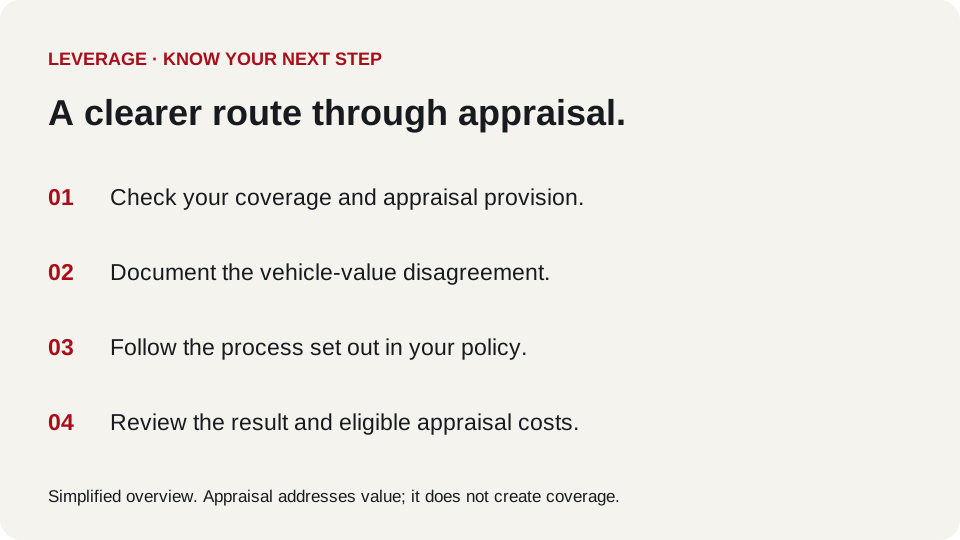
Before you start: check the assignment.
Collect the policy provision, last written offer and full valuation. Identify whether the disagreement is value, coverage, repair scope or liability. Request a fee and scope explanation. LEVERAGE begins with a free review to see whether our service fits.
Your appraiser develops an independent valuation.
The work should explain the vehicle configuration, the comparison set and the relevant differences. You can supply records and factual corrections, but the conclusion must follow the evidence. Technology can assist research; the appraiser remains responsible for the analysis.
The two appraisers consider the disagreement.
Your appraiser and the insurer’s appraiser compare evidence under the policy’s procedure. There is no reliable promise that every appraisal ends in a fixed number of days. Vehicle complexity, access to records and the remaining differences affect the work.
An umpire may be needed.
Read the policy’s selection procedure and cost terms before starting. If the appraisers cannot agree, an umpire may become involved. Ask how an award is reached, who signs it and what additional costs may apply.
Keep the award and reimbursement paperwork.
Retain the signed outcome, previous offers, invoice and payment records. Compare the resulting settlement statement with the award and ask about any deduction you do not understand.
Choose an appraiser for the work that matters.
- Ask about actual vehicle valuation experience, not only repair estimating.
- Ask who develops and signs the appraisal and who communicates with the opposing appraiser.
- Ask whether the appraiser works for consumers, insurers or both.
- Verify the relevant credentials and request the fee and assignment scope in writing.
- Ask how unusual equipment, prior damage, imported vehicles and sparse comparable inventory are researched.
Appraisal-clause questions, answered.
Does appraisal guarantee an increase?
No. An independent appraisal must follow the evidence. A free review helps assess the assignment before you commit, but no page or calculator can promise a particular outcome.
Is this the same as hiring an attorney?
No. LEVERAGE provides vehicle appraisal services. A coverage denial, liability dispute or legal question may need a separate professional.
Will the process take over every part of my claim?
Our own-policy appraisal work concerns vehicle value under the appraisal provision. Rental benefits, injuries, coverage decisions, loan issues and other disputes are not automatically included. We explain the assignment before you hire us.
How much does LEVERAGE charge?
Your Red Flag Review is free. Appraisals start as low as $399. We quote the assignment and flat fee before you hire us; we do not charge a percentage of your increase.
Can I recover my appraisal cost in Oregon?
For an eligible own-policy appraisal, Oregon requires reimbursement of reasonable appraisal costs when the final appraisal decision exceeds the insurer’s last offer made before the appraisal costs were incurred. Keep the final valuation, last offer and paid invoice. Ask us about documenting the reimbursement request.
Before you invoke the clause, get these answers.
What exactly is the disagreement?
A wrong value is an appraisal question. A denied loss, excluded driver, policy cancellation or dispute over who caused the crash may be a coverage or legal issue. A higher appraisal does not resolve every reason an insurer may decline payment.
Who actually does the work?
Ask for the appraiser’s name, relevant credential, vehicle-valuation background and who will communicate with the opposing appraiser. Oregon’s statute recognizes specified credentials issued by Oregon, another state or a governmental body. A private certificate alone is not the same thing. Verify the applicable credential and ask about actual Oregon market experience.
What does the flat fee include?
For LEVERAGE own-policy appraisal-clause assignments, the appraisal and communication with the opposing appraiser are included in the agreed scope. Ask about possible umpire costs before proceeding. We do not take a percentage of your increase.
What does a good award look like?
Keep the written valuation decision and the signatures required by your policy. Reconcile the decision with the final payment statement. A verbal “we agreed” is not a substitute for the document you will need when requesting reimbursement.
Wording you can adapt
Please provide the appraisal provision in the policy applicable on my loss date, including any endorsements that change it. I am evaluating the procedure for a disagreement over vehicle value. Please also confirm the last written offer and the status of inspection access.
Three Oregon protections worth understanding.
The report behind the offer
ORS 742.554 requires the valuation or appraisal reports relied on for the total-loss cash offer, along with the required notice. Ask for every page and each revision. This applies to an insured or a third-party vehicle owner; receiving a report does not create a right to invoke someone else’s policy.
The amount that is not in dispute
Under ORS 742.558, payment of the undisputed vehicle value requires agreement to execute ownership-transfer documents and authorization for an insurer-paid move to a disclosed location. The vehicle must remain available there for inspection and evaluation for at least 14 calendar days. After that period it may be sold for salvage. Acceptance of that statutory payment alone does not waive the additional value claim. Read any separate release before signing; arrange inspection promptly.
Reasonable appraisal-cost reimbursement
ORS 742.466 requires reimbursement of reasonable appraisal costs when the policy provides appraisal and the final appraisal decision exceeds the insurer’s last offer made before the costs were incurred. The law does not require a $1,000 increase. It does require the applicable conditions and reasonable costs. Keep the last offer, award and invoice; do not assume this applies to a report purchased for a third-party claim.
Sources and useful documents
General information for Oregon vehicle owners. Your policy, coverage and claim facts matter. Coverage disputes and legal questions may require separate professional advice.
Get the Advantage. Get LEVERAGE™.
I Know the Tricks. I Know the Trade. I Know Who I Fight For.
We Fight for Oregon Consumers.
Send the report and tell us what does not look right. A free Red Flag Review helps you decide whether an independent appraisal is the next step for your vehicle.
Keep learning.
Choose another guide
- Dispute a Total Loss Settlement
- My Car Is Totaled: Oregon Guide
- Total Loss Valuation Report Guide
- State Farm Total Loss Appraisal Clause Disputes in Oregon
- Progressive Total Loss Appraisal Clause Disputes in Oregon
- GEICO Total Loss Appraisal Clause Disputes in Oregon
- Can I Reject a Total Loss Offer in Oregon?
- Total Loss Valuation in Oregon
- Fair Market Value vs. Appraised Value in Oregon
- Oregon Vehicle Valuation Evidence Worksheet
- Oregon Total Loss Storage Fees
- 20 Questions Before Hiring an Oregon Total Loss Appraiser
- Negotiate an Oregon Total Loss Claim Yourself
- How to Improve Your Oregon Total Loss Settlement With Photos
- I’ve Totaled My Car in Oregon: How Do I Get a Fair Settlement?
- Oregon Car Insurance Total Loss Claim Laws
- How to Dispute Total Loss Value in Oregon
- Oregon Total Loss Insurance Claims
- Total Loss Oregon: Understand Your Options

